
Wendy Killoran
The Ausable River emerged at Lake Huron’s shoreline with a wide, beckoning gap enticing us to paddle the Great Lake for the first paddle of the season in late March. It had been quite unexpected as Doug and I had just snowshoed two weeks prior on the frozen lake and now, a vertical wall of dripping, sand-covered ice rimmed the sandy beach and dunes. Flat pewter-coloured water reached to the far western horizon. A halo of high clouds circled the sun creating a sundog and warm, saturated colors bathed our watery world.
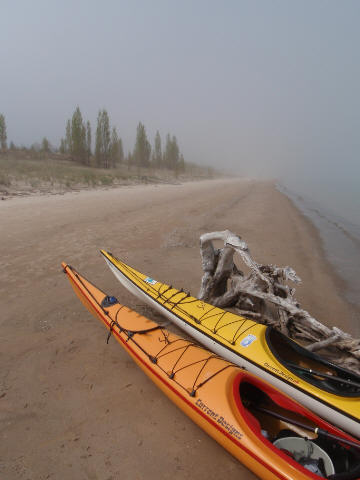 According to Doug, I was wearing a “perma-grin”. Water seems to have that effect on me. Doug was new to kayaking but not new to being on the water, having grown up windsurfing and swimming on the Georgian Bay. I’d introduced him to my favourite playground in late October. He’d experienced the wild October gales sandblasting us on the beach, the serenity of snowshoeing the rare oak savanna woodlands in the depths of the winter, and now, Lake Huron was welcoming him with open arms into a new and wonderful aquatic playground.
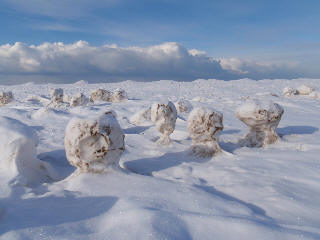
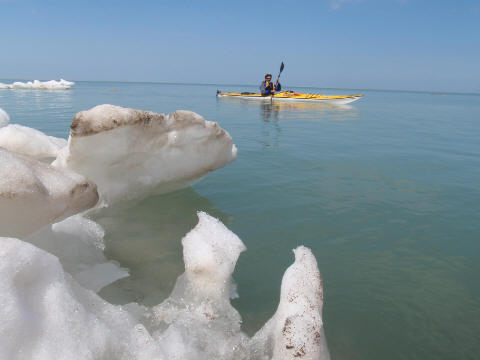
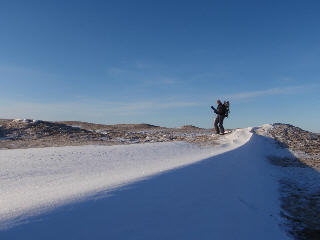 I decided to climb onto a slab of ice stranded on the shallow sandbar. Once back in the kayak, we paddled slowly amongst the floating chunks of ice while weaving our way along the wall of ice sculpted in waves and gouges with the drips from our paddles almost intrusive upon this silent realm. Solitude was plentiful. It seems that the shoulder season keeps all but the most intrepid outdoors people away. We had the shoreline for the entire day to ourselves yet, southwestern Ontario has one of the highest population densities of Canada. Temperatures were cool but the lack of wind made the open water journey bearable although my fingertips felt chilled even wearing neoprene gloves.
Clouds became more prominent as the hours of daylight waned and we headed southwest towards the Ausable River’s mouth at the cottage community of Port Franks. Silver flecks scintillated on the water’s surface. The dream-like tranquility soaked deep within my core as I felt a harmony flow within myself. The first paddle of the season, following a long, icy winter, resonated with me, unleashing a childish sense of glee, having replaced snowshoes by kayak.
We backtracked down the Ausable River past the empty wharves at Port Franks and then ducked into the barely visible Ausauble Cut, a manmade cut dug in 1876 and which is fed by natural springs found in the extensive dunes. This journey through the narrow, shallow cut caused us to disembark, pulling the kayaks over half a dozen beaver dams as we re-entered the park. A sick and weary raccoon lay at river’s edge, not moving, just looking at us with lackluster eyes. Flocks of colourful buffleheads rested on the water, several with baby buffleheads, biding time in their migration northwards to their northern lakes and ponds breeding grounds. A flock of white tundra swans flew in a vocal V-formation towards the lake. Monstrous beaver lodges lined the muddy banks. Our first paddle of the season had brought numerous unexpected surprises, including the opportunity to paddle Lake Huron amongst an art gallery of ice sculptures.
I am thankful for this unique provincial park on the eastern shore of Lake Huron just south of Grand Bend and thankful too for the government’s foresight in creating a protected natural area, procuring the Pinery in 1957 and opening it to the public two years later. Even as a young baby, I’d had the opportunity to experience the Pinery, a place of varied habitats: oak savanna forests, coastal sand dunes, sand and pebble beach, and the expansive lake resembling the vastness of an ocean.
 Luckily for us, the Pinery is only an hour’s drive from my home in land-locked London, but it seems eons away from the frenetic life most endure in southwestern Ontario and only seems to draw the large crowds between Victoria Day and Labour Day. At its peak in the 1970s, more than 1.5 million visitors visited the park annually. This has diminished to about 500,000 visitors annually. Today, the park’s 6,330 acres protects almost fifty percent of the world’s remaining oak savanna, an ecosystem that displays the transition between prairie grasslands and oak forests. Its unique combination creates open woodlands with about 35% canopy coverage. The coastal dunes adjacent to Lake Huron creep inland, carved by the forces of the wind, where the oak savanna with Carolinian species such as ironwood, shagbark hickory and sycamore, forest the ancient dunes. These dunes existed some 4,000 to 6,000 years ago when glacial melt from the last great Ice Age created a super-sized glacial lake known as Lake Nipissing, and water levels were some 8 or 9 metres higher than they are currently. As a result, the sandy soil saved this area from being settled and farmed.
Lake Huron holds onto a lengthy list of boasting rights. It is the second largest Great Lake, second only to Lake Superior, with a surface area of 59,596 square kilometres making it the third largest freshwater lake on the planet (depending on which source one uses). Although its average depth is 59 metres, the lake’s deepest point is 229 metres. It has the longest shoreline of the Great Lakes, including the shoreline of the 30,000 Islands, with an estimated 6,157 kilometres of shoreline. Manitoulin Island, the world’s largest freshwater island located in the northern portion of Lake Huron, is a notable feature that separates Lake Huron from the North Channel and the Bruce Peninsula that separates Lake Huron from the Georgian Bay. The North Channel and the Georgian Bay are considered part of Lake Huron, which originally had been called Lake Manitoulin according to one source. Early French explorers had referred to it as La Mer Douce, the freshwater sea. However, on most early maps, Lake Huron was labeled as “Lac des Hurons,” Lake of the Huron Indians.
This special place nurtures my soul and now too, Doug felt a magnetic pull to this place, where Nature continues to offer new experiences, regardless of the seasons. When the lake is churned into a frenzy of harrowing waves, the Ausable Cut offers respite from the open fetch of the lake and provides a completely different kayaking experience, nestled in the heart of one of the very last remaining stands of oak savanna in the world.
On another exploration at the Pinery in early April, we again explore the Ausable Cut. With trees naked, leaves not yet unfurled, we look deep into these open woods, covering ancient dunes from the receding waters from the last great ice age some ten thousand years ago.
Chickadees sing their “chick-a-dee-dee-dee” song and painted turtles bathe in the sun on rotting logs that lie at a low angle which is suitable for these cumbersome creatures to crawl upon. Our silent approach, as we drift on the sunny side of the cut, causes turtles to remain motionless, shells shining as they absorb the sun’s energy, or to plop into the river inches below, to swiftly disappear from our intrusive arrival. A lone kingfisher chortles urgently as it rapidly follows the tree-lined shore.
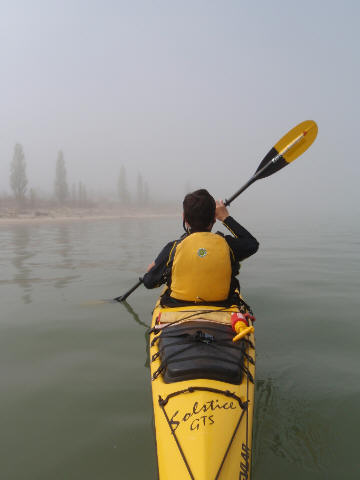 We paddle absorbed in our surroundings, the verdant hues of spring not yet revitalizing the forest and river bank. A less inviting hue of withered brown oak leaves on the forest floor combined with the rough grey bark of the Carolinian trees paints a subdued picture. Not a single canoe or kayak, other than our own, meander along the awakening shoreline. A great blue heron stands motionless, camouflaged next to a thin vertical branch. Pairs of Canada geese eye us as we veer away. They are building nesting sites. Several dozen painted turtles are counted as they sunbathe on the partially submerged logs barely extruding from the water’s surface.
The river offers its own unique natural wonders, but it is wide open places I find compelling and that tug at my soul. The river dictates my direction of motion and feels somewhat claustrophobic. Lake Huron, less than a kilometre distant, can be heard as a soft murmur as the swells break over the series of sand bars parallel to the more than ten kilometres of sandy beach shoreline. The forest floor is painted in an artistic chiaroscuro design, like a delicate doily dappling the leafy carpet.
We pull ashore and spread a cotton sheet on this inviting carpet under this delicate soft display of shadow and light, reading our books to the sound of song sparrows and the occasional glimpse of soaring vultures.
We choose to avoid the busy summer months months when the park is heavily used and offers camping in three separate campgrounds. We content ourselves with day trips mostly in the spring, autumn, and winter, often arriving at the crack of dawn and departing well after sunset even though camping is available throughout the year.
High winds, searing sunshine, fluffy snowfalls or brisk sunny days entice us to explore every nook and cranny of this park, kayaking on Lake Huron, kayaking on the Ausable Cut, or snowshoeing the interior woods over ancient dunes. It never disappoints. Thankfully, the dunes are off limits to camping, their sensitive habitat kept in a natural state with boardwalks traversing these dunes to water’s edge.
Behind the first ridge of dunes, is a micro-niche that experiences extreme conditions. In the summer time, temperatures can exceed 70 degrees Celsius. Plants adapt for survival like plants in large scale deserts, with rhizomes penetrating deep in the sand, plants possessing waxy leaves to resist dehydration or by having silky hair-like growths shading stems from these harsh conditions. But as sand shifts, plants succumb to the conditions. These parabolic dunes are growing since the sands are from the beach, blowing inland. With the prevailing northerly water currents of Lake Huron scouring particles off bedrock to the north, and the impediment of Kettle Point to the south, sands are deposited here in vast quantities annually creating lengthy beaches and towering dunes. These sand particles and frequent waves scour the pebbles found in patches along the water’s edge which were originally deposited here by the melting glacier, polished smoothly to provide a varied sampling of the rocks found in Ontario as far north as the Precambrian Shield, with jasper conglomerates, smooth banded siltstone, as well as coral fossils as my favorite finds. Yet in the winter, behind this first ridge of windswept dunes, the blanketing layer of snow is usually blown away, subjecting this environment to equally frigid conditions.
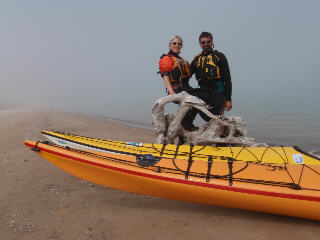 Doug and I visit almost weekly. We’ve spotted numerous creatures this year including musk turtles, painted turtles, snapping turtles, numerous bald eagle sightings, muskrat, beaver, opossum and a coyote as well as damselflies and a curious “walking stick” insect. We watch monarch butterflies migrate southwards, their lightweight bodies buffeted at the whim of the westerly winds. Although deer reside here and their hoof prints meander throughout the park, we have not seen one this year although we are aware that aggressive culling of the population takes place annually.
Doug has now spent a year exploring the Pinery intimately, just as I have over a lifetime. The rare oak savanna with Carolinian species, the expansive view of Lake Huron with not a single dwelling on its shores for over ten kilometres, and the vitality of the Ausable Cut, continues to draw us here.
This provincial park has been my playground since I was still young enough to sit on a potty. Now, the park has become our special place. It is where we fell in love with each other, where we play weekly and revitalize our spirits, as well as where we are able to explore and learn about this unique and rare environment.